

Sadness and anger are deeply connected; often, anger masks unrecognized sadness, fear, or loneliness. By accurately naming our emotions — especially in the face of trauma or long-term stress — we can break cycles, communicate honestly, and move toward healing and connection.
Share this with someone who needs it
Follow Jonathan Arenburg
For thoughtful conversations about mental health, modern life, human biology, and what it means to stay connected in a disconnected world.

The second my feet touch the mat beside my bed, my inner world starts its familiar tug-of-war — a clash of emotion, negative self-talk, and my authentic self. Sometimes this conflict comes and goes as fast as a lightning strike.
In a post I wrote for The Road To Mental Wellness called Name That Emotion, I talk about how often we confuse one feeling for another.
Take anger, for example. On the surface, anger seems obvious: “I’m mad at you because you won’t spend time with me.” But the true emotion beneath that reaction can be something entirely different.
What if anger is simply the only way someone has learned to express another uncomfortable feeling — like sadness?
That’s the value of therapy. It helps you reassign the emotion you think you’re feeling to the emotion you’re actually experiencing.
“I feel sad when you don’t spend time with me.”
Something shifts when you match the right name to the right emotion.

If you feel tears building, a heaviness in your chest, and a sinking feeling in your stomach — especially after someone you care about fails to show up for you — that’s sadness. But sadness can be hard to approach. Many of us default to anger because it feels more powerful, less exposed.
Here’s a reference point — what sadness commonly feels like:
In the Body
- A heavy chest, like something is pressing down inside the rib cage
- A tight throat that makes it harder to speak or swallow
- Burning eyes — that warm sting before tears come
- Slumped posture
- Low energy, where everything feels harder to initiate
- A hollow stomach or loss of appetite
- An overall heaviness, as if carrying extra weight
In the Mind
- Foggy thinking, slower or scattered thoughts
- A sense of emptiness
- Hopeless or defeated thoughts
- An urge to withdraw or be alone
- Softer but persistent self-criticism
Emotionally
- A quiet ache
- Longing for connection or comfort
- Loneliness, even around others
- A tender, emotionally bruised feeling

When Difference Feels Like Danger
When difference feels like danger, the ancient brain can turn disagreement into threat. This article explores how digital division, fear, and emotional reactivity shape the way we see one another—and why awareness is part of the repair.
Keep reading
Something went wrong. Please refresh the page and/or try again.
Sadness and Anger: A Thin Line
We’ve all heard the expression, “There’s a fine line between love and hate.”
The same is true for sadness and anger.
Both emotions often rise from unmet needs. When we are rejected, ignored, or dismissed by someone we care about, the lines between sadness and anger can blur. Over time, they can become so intertwined that anger becomes the default reaction — not because it’s the truest one, but because it’s the most familiar.
Because anger is powerful, it can easily override the quieter emotions beneath it.
Yelling, stomping off, going silent — these behaviours often mask heartache and loneliness. Anger becomes the armour.
Most people never make the connection, and that’s why the anger cycle keeps repeating:
- “You’re always angry.”
- “Well, you never pay attention to me.”
- “It’s hard to want to spend time together when you’re always yelling.”
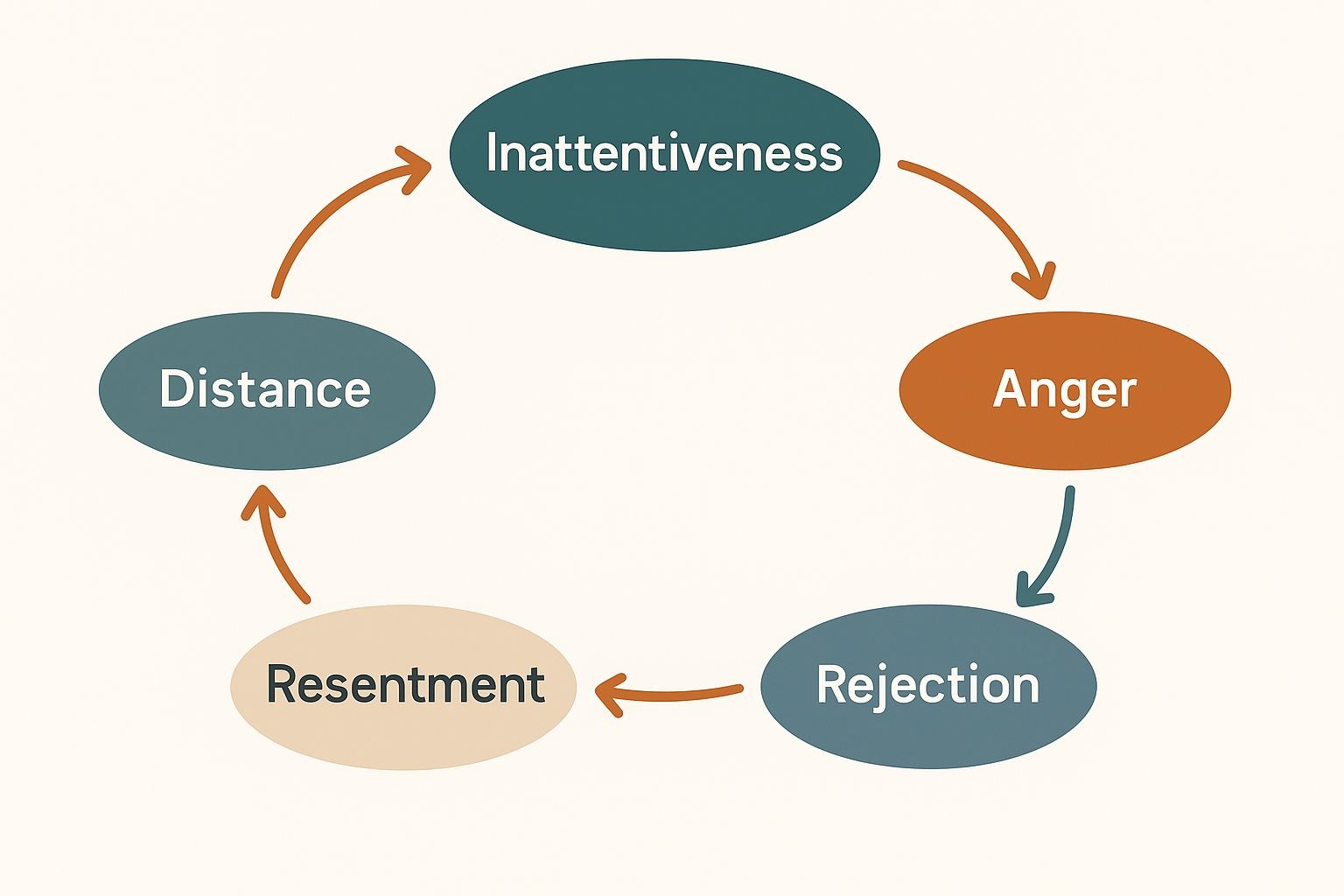
And so the loop forms: inattentiveness → anger → rejection → resentment → distance. I call this the The Maladaptive Relationship Cycle.
The Maladaptive Relationship Cycle

The angry response then leads to rejection, as the other partner pulls away to avoid conflict. That sense of being pushed aside feeds resentment, a heavy emotional residue that builds when needs go unmet. Over time, resentment creates distance, both emotional and physical, leaving each person feeling misunderstood, unseen, or unsafe.
This cycle is maladaptive not because either partner is “faulty,” but because the emotional reactions they rely on no longer serve their relationship. Naming the real feelings—especially the sadness hidden beneath anger—is often the first step to breaking the pattern and rebuilding connection.
When We Learn the Difference
Living with PTSD, I’ve had my share of sudden reactions to uncomfortable moments. When PTSD speaks, it speaks from a place of “I don’t feel safe.” My reactions used to come with what I call the burn-it-down effect.
If a friend didn’t call or initiate contact, I’d fixate on their absence.
The anger built slowly.
Thoughts got louder:
“If they cared, they’d reach out.”
“Why do I always have to be the one trying?”
That anger — fueled by a manufactured sense of rejection — acted like a fuse. Eventually, BOOM. I’d burn down the friendship in a burst of emotion. I’d ghost, lash out, or pull away entirely. Rejecting them before they could reject me felt easier.
But underneath the anger was something much softer: loneliness and sadness.
It’s hard to move through life feeling like a lost traveller, standing in the same familiar places yet never feeling at home. Not feeling safe anywhere only fuels that transformation — sadness turning into a mountain of anger.

Toxic or Not? Defining the Line in Challenging Relationships
“What makes a relationship truly toxic? Is it the presence of mental health struggles, or the refusal to seek help? 💭 Living with PTSD, depression, or anxiety can be incredibly challenging—for both the person suffering and their loved ones. But does that make someone toxic? Or is toxicity more about intent?
In my latest post,…
Keep reading The Road to Healing
As heavy as my story might sound, there truly is light at the end of the tunnel. Today, I am less reactive and more at peace than ever before.
Learning to identify sadness — to name it accurately — has been one of the biggest reasons for that peace.
Now, when I feel myself heading toward an anger episode, I pause and say:
“What you’re feeling is sadness. You’re not angry at this person. You just want them to show up a little more in your life.”
That simple reframe is calming. When feelings are identified correctly, you can sit with them. You can simply allow yourself to feel sad — without setting the world on fire around you.
I wouldn’t have learned this without therapy. Years of work taught me to tell the difference between what I think I’m feeling and what I’m actually feeling.

Exploring Different Types of Therapy for Mental Health
Discover different types of mental health therapy, from CBT to art and animal-assisted therapy. Find the right fit for your journey to healing. Exploring Different Types of Therapy for Mental Health Introduction Finding the right therapy can feel overwhelming, but it’s worth the effort. Guided support through different therapy options can help you match your…
Keep reading If there’s one takeaway, it’s this: go to therapy. Keep showing up until you find the mental health professional you connect with. Getting to the root of what’s happening inside can transform not only your relationships with others, but also the constant push-and-pull that happens in your own mind.
I’m rooting for you,
Jonathan


Join the conversation
If this resonated—or challenged you—I’d genuinely like to hear your perspective. Thoughtful disagreement and lived experience are welcome.
Scroll down to the comments below. Please keep it respectful—this is a space for honest, human conversation.