
Discover the Neurocultural Wellness Framework—a practical, science-backed approach to mental health featuring five pillars of well-being: body and brain safety, social connection, purpose, supportive environment, and self-compassion. Apply it in your life today.
Share this with someone who needs it
Follow Jonathan Arenburg
For thoughtful conversations about mental health, modern life, human biology, and what it means to stay connected in a disconnected world.

Mental health isn’t one-size-fits-all. Real life is unpredictable, often overwhelming, and never as tidy as we’d like. Whether you’re living with trauma, chronic stress, or just feeling the daily pressure of a fast-moving world, you know there’s no simple formula for well-being.
That’s why I came up with this model:

Download and Share – Keep it Handy to Keep you Motivated
The Neurocultural Wellness Framework Explained
The Neurocultural Wellness Framework isn’t just another set of wellness tips—it’s a map for navigating the messiness of being human. This model recognizes what science and experience keep showing us: our minds and bodies need more than willpower or good intentions. We need safety, connection, purpose, supportive environments, and self-kindness. we need to remember we were never meant to do it alone.

When Difference Feels Like Danger
When difference feels like danger, the ancient brain can turn disagreement into threat. This article explores how digital division, fear, and emotional reactivity shape the way we see one another—and why awareness is part of the repair.
Keep reading
The Five Pillars of the Neurocultural Wellness Framework
1. Body & Brain Safety
Your mind and body need to feel safe, rested, and cared for.
Well-being begins with the basics: sleep, nutrition, movement, and the freedom from constant threat or overload. When your nervous system is in survival mode, higher-level healing isn’t possible. Modern life often neglects this fundamental need—if you’re always exhausted, overstimulated, or living with uncertainty, this is where to start.
2. Social Connection & Interdependence
We thrive together—real belonging means giving and receiving support.
Human beings are wired for connection. Social connection goes beyond just being around people; it means forming bonds where support, trust, and vulnerability flow both ways. Interdependence isn’t a weakness—it’s how we survive and grow. If you’re feeling isolated or unsupported, this pillar is a powerful place to focus.
3. Purpose & Choice
Having control in your life and reasons to get up in the morning.
We all need a sense of meaning and the ability to make choices that matter. Feeling powerless or without direction can drain your motivation and hope. This pillar is about reclaiming a sense of agency and building purpose, even if it starts with small steps or personal projects. Read: Finding Your Passion and Purpose: Even when life takes you off course
4. Supportive Environment
Living and working in places that fit human needs—calm, healthy, and fair.
Where you live, work, and spend your time shapes your mental health more than most people realize. A supportive environment is one that respects your needs for quiet, safety, fairness, and genuine rest. It could be as simple as organizing your home, seeking out green spaces, or advocating for better workplaces. Changing your environment isn’t always easy, but even small adjustments can make a big difference.

Find More Inspiring Mental Health Content at: theroadtomentalwellness.com
5. Self-Compassion
Being kind to yourself and rewriting unhelpful inner stories.
Too often, we’re our own harshest critics. Self-compassion is the foundation for healing and resilience. It’s about treating yourself with the same patience and forgiveness you’d offer a friend. Part of this pillar is also about narrative repair: noticing the old scripts that keep you stuck and starting to write new ones that support growth and acceptance.
Related

Understanding Maslow’s Hierarchy of Needs: A Foundation for Mental Wellness
Boost your mental wellness by understanding what truly drives us. 🧠💡 Check out our latest visual guide to Maslow’s Hierarchy of Needs—see how each level shapes your well-being.
How to Use the Framework
- Start where you are: No one has every pillar perfect. Scan the five areas and ask yourself which one needs the most attention right now.
- Look for imbalance, not failure: If you’re struggling, it’s usually a sign that one or more pillars is out of balance—not that there’s something “wrong” with you.
- Remember: All pillars are connected. Progress in one area will often help strengthen the others.
- Use it as a compass: Whether you’re reflecting on your own life, talking with a friend, or working with a professional, let this framework guide your next steps.
- Check back regularly: Life changes—so will your strengths and needs. Revisit the model often as a check-in tool.

Why This Model Matters
The Neurocultural Wellness Framework isn’t about “fixing” yourself to fit a broken world. It’s about naming what you actually need to thrive—and recognizing that you’re not supposed to do it alone. True wellness grows out of connection, purpose, supportive spaces, and self-kindness.
In a culture that pushes hyper-independence and endless hustle, this model is a reminder that our needs are human needs—not personal flaws. It’s a map for healing, growth, and reclaiming the life you deserve.
Download the Neurocultural Wellness Framework graphic, share it with your community, or use it as a daily reminder. Your needs matter—and you’re not alone on this journey.
What do you think?
Let us know in the comments and please, like and share.


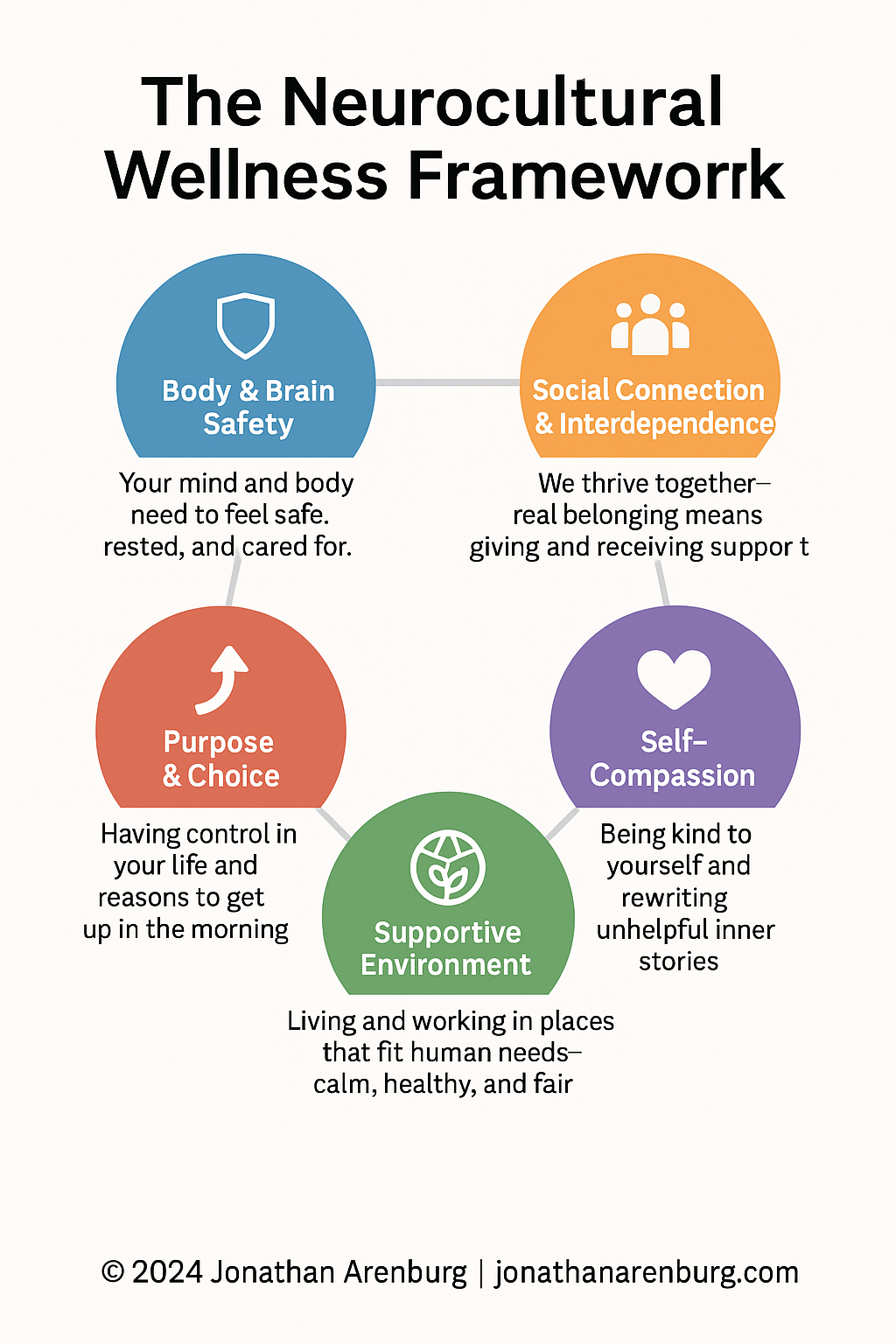
The Neurocultural Wellness Framework
© 2024 Jonathan Arenburg | jonathanarenburg.com
References
1. Body & Brain Safety
- McEwen, B. S. (2007). Physiology and Neurobiology of Stress and Adaptation: Central Role of the Brain
PDFs on university sites (example):
https://www.healthandenvironment.org/uploads-old/stress%20adaptation%20brain%20McEwen%2007.pdf
Summary (not official but accurate):
https://rootinnature.ca/research/nature-and-mental-health-an-ecosystem-service-perspective/ - Sleep & mental health (Matthew Walker’s Why We Sleep summary):
https://www.healthrising.org/blog/2020/03/23/why-we-sleep-fibromyalgia-chronic-fatigue-walker/ - Sleep Foundation overview with citations:
https://www.sleepfoundation.org/mental-health
2. Social Connection & Interdependence
- Holt-Lunstad, Smith & Layton (2010), Social Relationships and Mortality Risk: A Meta‑analytic Review (open access):
https://journals.plos.org/plosmedicine/article?id=10.1371/journal.pmed.1000316 - Cacioppo et al. (2015), Social relationships and health: The toxic effects of perceived social isolation:
https://www.ncbi.nlm.nih.gov/pmc/articles/PMC4332558/
3. Purpose & Choice
- Hill & Turiano (2014), Purpose in Life as a Predictor of Mortality Across Adulthood (summary and abstract):
https://scispace.com/papers/purpose-in-life-as-a-predictor-of-mortality-across-adulthood-4pefmtvbhj - ResearchGate full paper (author-uploaded):
https://www.researchgate.net/publication/262225995_Purpose_in_Life_as_a_Predictor_of_Mortality_Across_Adulthood
4. Supportive Environment (Nature)
- Bratman et al. (2019), Nature and mental health: An ecosystem service perspective (open access):
https://www.science.org/doi/10.1126/sciadv.aax0903
5. Self-Compassion
- Neff & Germer (2013), A Pilot Study and RCT of the Mindful Self-Compassion Program (author site PDF):
https://self-compassion.org/wp-content/uploads/publications/Neff-Germer-MSC-RCT-2012.pdf