

Share this with someone who needs it
Follow Jonathan Arenburg
For thoughtful conversations about mental health, modern life, human biology, and what it means to stay connected in a disconnected world.
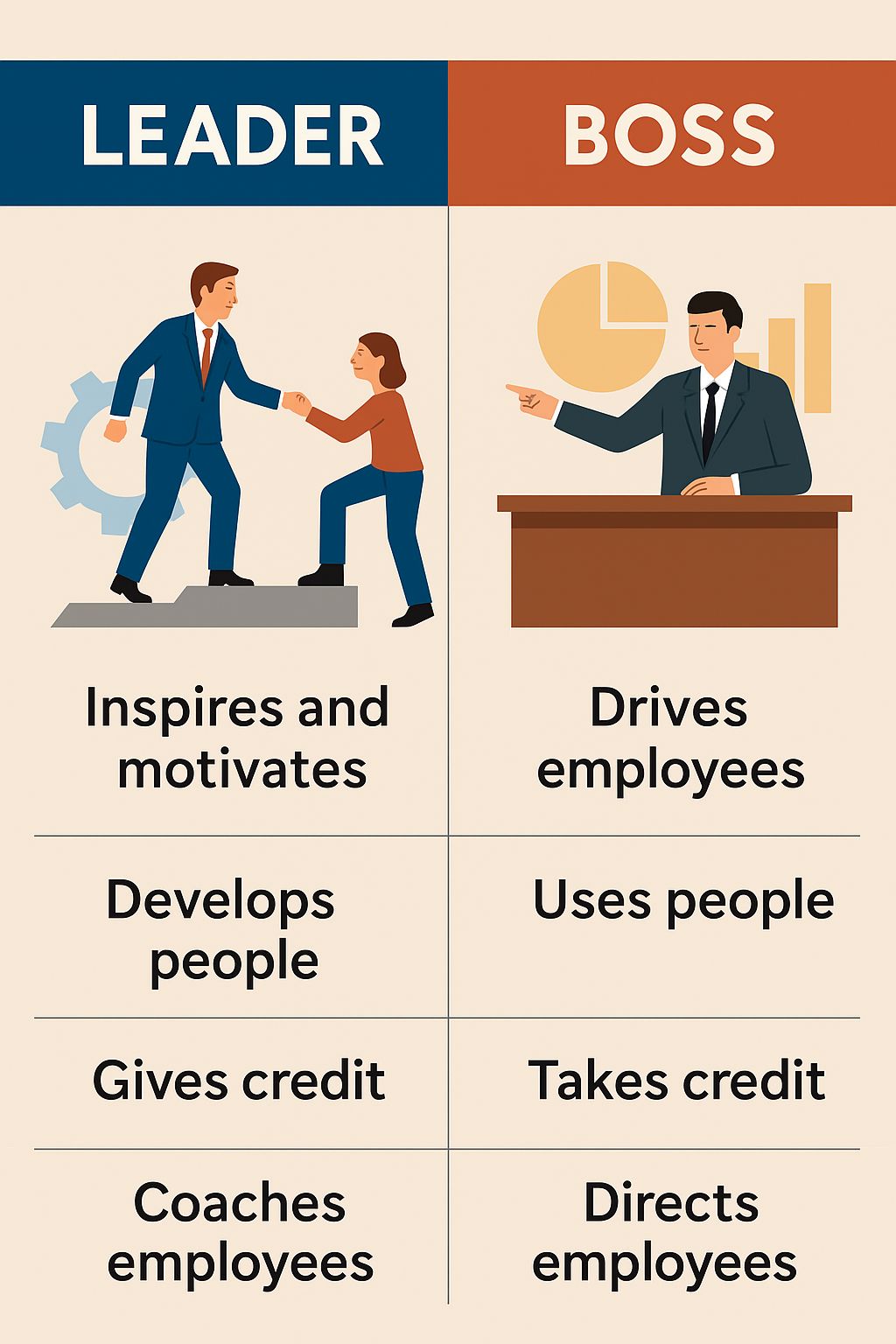
What do you think of when you hear the word leader? … A CEO with the power to fly anywhere at will and enjoy the most lucrative position in the company? Or maybe you think of a department manager… This is where the debate of leadership vs bosses begins In thinking about them, do you often ask yourself, “Why do they get all the perks like longer vacations and their own parking space?”
Here’s something I bet you never asked yourself: What is leadership? Let’s answer that question.
Defining Leadership
Leadership is the ability to guide, influence, and inspire others toward a shared vision or goal while fostering trust, respect, and collaboration. It goes beyond authority or titles—it’s about setting direction, making decisions with integrity, and taking responsibility for outcomes.
True leadership involves listening as much as directing, empowering others to contribute their strengths, and adapting to challenges with resilience and clarity. At its core, leadership is not just about achieving objectives but about creating an environment where people feel valued, motivated, and capable of growth.
Why Good Leaders Are Hard to Find
All good stuff, right? These are the ingredients that make up a great leader. But if that’s true, then why don’t we see more of them? The reality is that amazing leaders do exist—but they are harder to find for several reasons:
Confusion between leaders and bosses. Many managers get stuck on the “I’m the boss, so do it because I said so” mindset.
Entitlement. A boss may believe they’ve earned perks rather than seeing leadership as a privilege to serve others.
Micromanagement. Feeling the need to constantly watch over people’s shoulders kills trust and initiative.
Punishment-driven culture. Too many workplaces still operate on disciplinary models. Think of employees punished for “excessive” sick time, even if their overall record is clean. Or HR departments that function more like in-house lawyers protecting the company than advocates for employees.
The list goes on.
You May also Like

Toxic or Not? Defining the Line in Challenging Relationships
“What makes a relationship truly toxic? Is it the presence of mental health struggles, or the refusal to seek help? 💭 Living with PTSD, depression,…
Keep reading
The Problem of Normalization
There’s another piece that rarely gets discussed: our human tendency to normalize anything.
Sometimes this is positive, like public health care. Other times it’s destructive, like governments making massive cuts to vital services under the banner of “balancing the budget”—a move that often proves more expensive in the long run.
In Canada, we see both: one deeply beneficial, one harmful. The way we frame things in our minds matters. Why? Because once we normalize something, we accept it—even when it isn’t right.
And this leads us back to the difference between a leader and a boss.
Leadership vs. Boss Culture and Impact
Studies show that poor management ranks among the top reasons people leave their jobs. Up to 75% of employees don’t leave because of wages or working conditions—they leave because of their managers.
Yet businesses continue to treat people with suspicion, as numbers rather than as human beings deserving of mentorship and respect. Instead of investing in training managers to be leaders, many companies focus on union-busting, demanding more hours with no extra pay, and rigid control structures.
Why? Because this model has been normalized. Management justifies it as “protecting against liability,” but the reality is different: it creates toxic environments, kills productivity, and hurts the bottom line. It also breeds high turnover and dissatisfaction.
Why the Old Model Is Outdated
This management model is not only outdated—it’s upside down. Healthy systems put people first and lean into human nature in positive ways:
Praise when it’s appropriate
Encourage creativity and expression of ideas
Listen actively and mentor staff
Respect work-life balance
These are not radical ideas. They detoxify workplaces, encourage growth, and improve both individual and organizational outcomes.
Real-World Proof That Leadership Works Differently
One powerful example came in 2015, when Dan Price, CEO of Gravity Payments, shocked the business world by setting a minimum salary of $70,000 for every employee. He even cut his own million-dollar salary down to $70,000 to make it happen.
Critics called the move reckless. The results proved otherwise:
Turnover plummeted, saving the company money and preserving talent.
Job satisfaction skyrocketed, boosting productivity.
Profits doubled within a few years, and by 2022, Gravity raised its minimum salary again to $80,000.
Employees reported life-changing benefits: buying homes, paying off debt, starting families, and achieving real financial security.
The company culture shifted from surviving to thriving. This is leadership in action—not perks for the few at the top, but shared success that lifts everyone.
More From Jonathan
The Bottom Line
Most of us want to work—and we want that work to feel meaningful. When it does, we deliver.
When organizations create environments where people are seen, heard, and valued, the ripple effects stretch far beyond balance sheets. Cultures built on trust and collaboration become magnets for talent. Employees stay and contribute because they believe in the mission, not just for a paycheck.
The benefits extend outward: engaged employees innovate, provide better customer service, and enhance the company’s reputation. It’s a positive feedback loop that debunks the myth that hard-nosed management works best.
The lesson is clear: it’s time to retire outdated, punitive models and embrace leadership that uplifts. Investing in people isn’t just ethical—it’s smart business. At the heart of every success story is the same truth: the collective achievement of people working together.
What do you think of when you hear the word leader? A CEO with the power to fly anywhere at will and enjoy the most lucrative position in the company? Or maybe you think of a department manager—the one who always seems to get time off when they want and has a reserved parking spot.
Here’s something I bet you never asked yourself: What is leadership? Let’s answer that question.
Checkout Jonathan’s Latest Book: WIRED TO BE HUMAN
Learn More About Mental Health and the Brain
WIRED TO BE HUMAN
Jonathan Arenburg: Author, Speaker, Trained Counsellor explores Why the Modern World Feels Wrong—and What Evolution Says About Making It Right in his latest book. WIRED TO BE HUMAN.


Welcome

Jonathan Arenburg
Author • Speaker • Trained Counsellor
Welcome to my official site. I’m Jonathan Arenburg, a Canadian writer, speaker and trained counsellor passionate about mental health advocacy. Here you’ll find my books, blog posts, and reflections — alongside past media appearances and speaking engagements. My goal is simple: to open up honest conversations about resilience, biology, and what it means to live fully as ourselves.
Jonathan Arenburg Has Appeared On
A collection of podcasts, interviews, collaborations, and speaking engagements featuring Jonathan Arenburg.
 The Healing Place
  CityNews
  SaltWire
  Sick Not Weak
  Depression Files
  Above Ground
  Addiction Rehab Toronto
  A New Dawn
Wired to Be Human Audiobook
Listen to Wired to Be Human in audiobook format on JonathanArenburg.com. Explore the ideas behind modern life, human biology, and mental well-being in a format designed for easy listening.

Reader Reviews for Wired to Be Human
★★★★★ “This book will open your eyes.” A powerful, evolution-grounded look at why modern life feels so mentally difficult — and how understanding our biology can help us reconnect and heal.
Explore the Book →Latest News
The Road to Mental Wellness Passes 50,000 Views
A major milestone reflecting years of consistent writing, lived experience, and reader connection.

The Road to Mental Wellness has officially passed 50,000 all-time views. Since launching in 2019, the blog has grown into a collection of 500+ articles exploring anxiety, PTSD, trauma, depression, and resilience through lived experience.
The Brain’s Alarm System — Why Anxiety Feels So Real
A deeper look at the biology behind anxiety and why it can feel overwhelming even in everyday situations.

I recently contributed this article to the LEAD Community Foundation, exploring how the brain’s alarm system drives anxiety—and why those reactions feel so intense and real in everyday life.
Breaking the Silence Podcast — Episode Now Live
A conversation on trauma, recovery, and the realities of mental health in today’s world.
Jonathan recently joined the Breaking the Silence Podcast, hosted by Addiction Rehab Toronto. The episode is now available to watch on YouTube.
Featured on The Healing Place Podcast
A meaningful discussion focused on resilience, healing, and understanding human behavior through biology.
Jonathan joined The Healing Place Podcast to discuss trauma, resilience, and how understanding our biology helps us make sense of anxiety and healing.
Podcast Interviews Available on jonathanarenburg.com
Breaking the Silence Podcast (Addiction Rehab Toronto)
A grounded discussion on mental health, recovery, and the real-life impact of trauma and support systems.

The Healing Place Podcast
A conversation on trauma, resilience, and how understanding our biology helps us make sense of anxiety and healing.
Explore Jonathan Arenburg’s Work, Books, and Mental Health Insights

Wired to Be Human
Why the modern world feels wrong—and what evolution says about making it right.

The Road to Mental Wellness
A candid memoir exploring PTSD, depression, and the path toward recovery.


Why Taking Responsibility for Your Life Changes Everything
Growth requires us to confront uncomfortable truths about ourselves. Instead of blaming others for our problems, we should take personal responsibility and examine our patterns. This inward reflection is crucial for mental wellness. Therapy can help unpack these issues, enabling us to shift from automatic reactions to conscious responses for lasting change.
Keep reading 
You Think It’s Just Noise—Here’s What PTSD Actually Feels Like
PTSD noise sensitivity PTSD noise sensitivity is something many people don’t fully understand—but for those living with it, everyday sounds can feel overwhelming in ways that are hard to explain. If you’re a North American dweller, you’re probably all hyped up for the warmer weather. Right now, mid-April, the winter has lost its strength as…
Keep reading 
Are We This Angry… or Is the Internet Changing Us?
Human behavior online isn’t random—it’s biological. This post explores how temperament and the modern digital environment collide, shaping reactions like anger, defensiveness, and withdrawal in ways we often misunderstand.
Keep reading Something went wrong. Please refresh the page and/or try again.
Want deeper reflections, personal essays, and practical mental health insights?
Explore The Road to Mental Wellness
If you’d like to read more in the longer-form blog format, you’ll find it all there.
Visit the BlogFurther Reading
- Gallup – No Employee Benefit Is More Important Than a Great Manager
https://www.gallup.com/workplace/232955/no-employee-benefit-no-one-talking.aspx - Inc.com – Why Are Your Employees Quitting? 75% Say It’s Because of Managers
https://www.inc.com/marcel-schwantes/why-are-your-employees-quitting-a-study-says-it-comes-down-to-any-of-these-6-reasons.html - SHRM – Future of Talent Retention Report: Why Employees Leave
https://www.shrm.org/executive-network/insights/future-of-talent-retention-report-why-employees-leave - Apollo Technical – Employee Retention Statistics You Need to Know
https://www.apollotechnical.com/employee-retention-statistics/ - Wikipedia – Employee Retention (overview of turnover causes, leadership impact, and career development)
https://en.wikipedia.org/wiki/Employee_retention
Join the conversation
If this resonated—or challenged you—I’d genuinely like to hear your perspective. Thoughtful disagreement and lived experience are welcome.
Scroll down to the comments below. Please keep it respectful—this is a space for honest, human conversation.